
Modelling the whole person, and whole populations, to understand brain health and mental illness across the lifespan.
We integrate genomics, neuroimaging, wearable and clinical data with machine learning to discover who is at risk for mental illness and neurodegeneration, and why, across the lifespan, from youth to late life.
Led by Daniel Felsky, PhD · Krembil Centre for Neuroinformatics, Centre for Addiction and Mental Health (CAMH) · University of Toronto
Get in touchOur approach
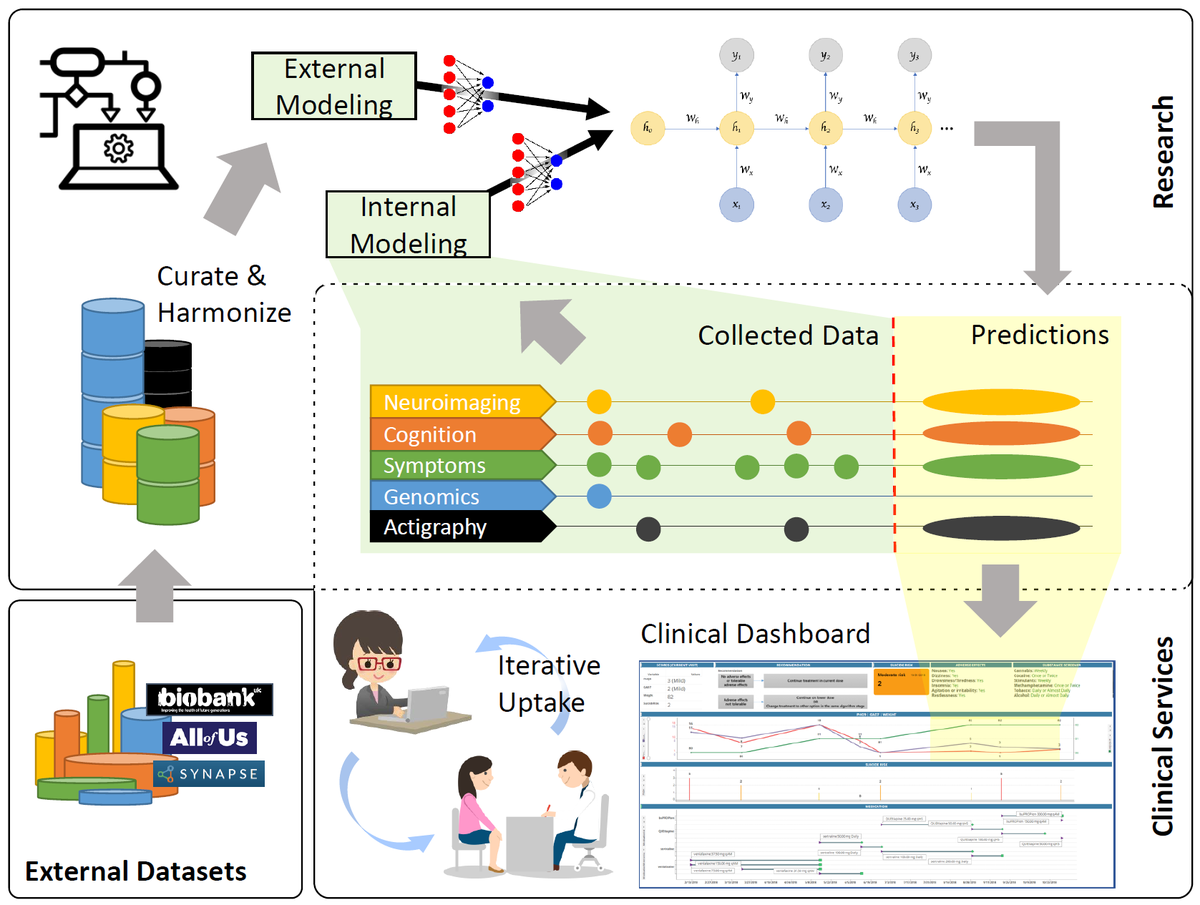
We bring together genes, brain, body, behaviour, and environment, integrating molecular, imaging, cognitive, wearable, and social data into unified models of mental and brain health across the lifespan, from youth to late life.
Research
Our program spans psychiatric and neurodegenerative conditions, united by a single idea: that mental and brain health emerge from the interaction of genes, brain, body, behaviour, and environment. These are our active research themes.
Using the Toronto Adolescent & Youth (TAY) CAMH Cohort Study, we model how psychosis-spectrum symptoms emerge in young people and search for blood- and MRI-based markers that predict who is at risk.
We build federated data platforms and predictive models that help integrated youth-mental-health services learn from their own data, improving care, equity, and measurement across Ontario and nationally.
We develop genomic, neuroimaging, and sleep-based machine-learning models to predict antidepressant response and treatment-resistant depression in older adults, and to map the shared roots of depression and dementia.
Through the Cognitive Dysfunction in the Addictions (CDiA) program, we combine genetics, blood, MRI, and wearable data to understand why some people with substance-use disorders lose cognitive function over time.
Our core genomics program builds polygenic, transcriptomic, and single-cell models of risk and resilience in Alzheimer's disease and cognitive aging, spanning the gut-immune-brain axis to tau spreading and brain reserve.
We pair single-cell transcriptomics with genetics to build gene-program-specific risk scores for bipolar disorder, and study its neuroimaging correlates and sex-specific cardiovascular comorbidity.
With collaborators, we are building a comprehensive brain-and-behaviour model of how the self-body image forms, while discovering biomarkers of its disturbance in eating disorders and body dysmorphic disorder.
We develop reproducible AI benchmarking platforms, digital-twin approaches to neurodegeneration risk and prevention, and open tools for multi-omic data integration (similarity network fusion).
How environmental exposures and early-life experience interact with genetic risk to shape brain development and mental health, including prenatal air pollution and childhood adversity. This is the environment pillar of whole-person modelling.
People
A transdisciplinary group of scientists and trainees spanning genomics, neuroimaging, biostatistics, computer science, and clinical research.

Principal Investigator
 DF
Postdoctoral Fellows
 ET
 MA
 SE
 MG
Graduate Students
 AL
 PL
 FN
 MP
 AM
 HL
 TA
 RV
 IC
 YT
Research Staff & Undergraduate Trainees
 AS
 MD
 AW
 LK
Alumni
Publications
A selection of recent papers from the lab. Trainee first authors are common; full lists are available via ORCID and Google Scholar.
Full, up-to-date list: Google Scholar · ORCID.
Resources
Datasets, analysis tools, and collaborator labs we draw on most often. Links open in new tabs.
Datasets & cohorts
Methods: genetics & polygenic scores
Methods: single-cell & multi-omics
Methods: neuroimaging
Methods: machine learning & statistics
Collaborators: Toronto & home institutions
Collaborators: international partners
Location & Contact
The Krembil Centre for Neuroinformatics (KCNI) at the Centre for Addiction and Mental Health brings together computational neuroscience, data science, and clinical research to understand the brain basis of mental illness and to accelerate discovery through open, data-driven methods. Our group is part of the KCNI community.
Centre for Addiction and Mental Health (CAMH)
12th Floor, 250 College Street
Toronto, Ontario, Canada M5T 1R8
CAMH is located in downtown Toronto, near the University of Toronto St. George campus.
Prospective students and collaborators are warmly welcome to reach out.
Programs, scholarships, and placements for students who want to train with us, across the University of Toronto, CAMH, the Institute of Medical Science, and Dalla Lana.
Undergraduate research & placements
Graduate programs
Scholarships, bursaries & funding